
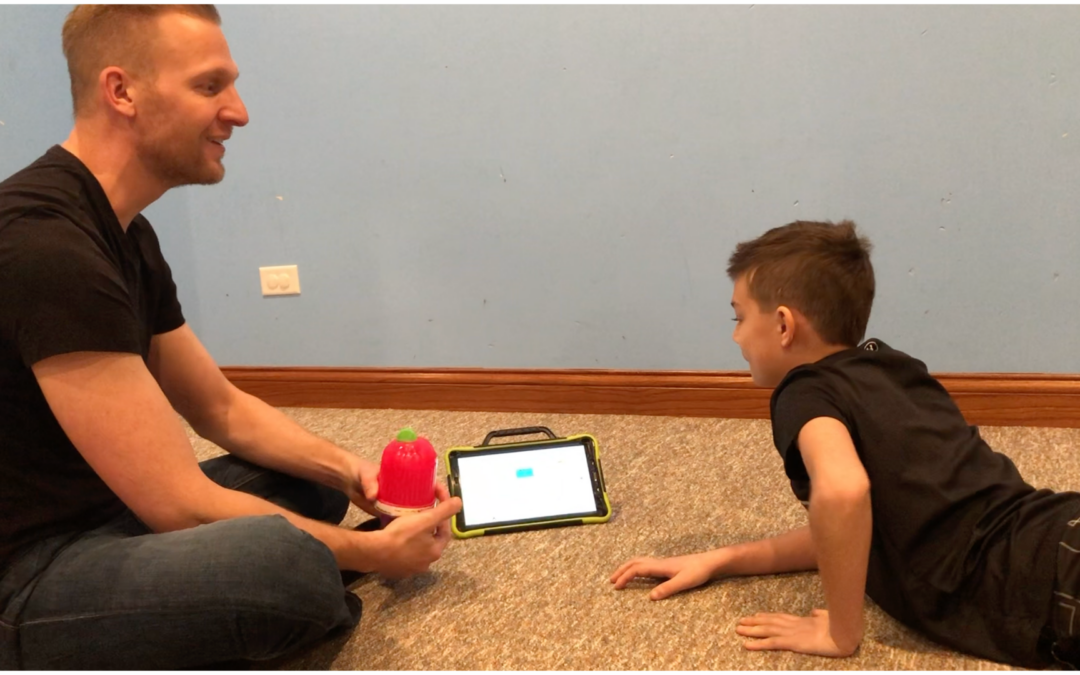
Some of the most powerful moments in communication therapy happen when nobody is talking.
In the SMoRRES® Training Program, we use a mnemonic to help communication partners remember every ingredient of successful modeling. The last “S” stands for STOP, and it may be the hardest one to do. The research backs this strategy up. Expectant pausing is an evidence-based strategy that’s associated with increased initiation.
What does it mean to stop?
Stop talking and stop modeling. Look at the child with a warm, expectant gaze, and wait.
Why does it matter?
When we ask a child to communicate, a lot has to happen. One of our colleagues calls it “mental gymnastics.” The child has to process what we said, figure out a reply, and plan the movements to respond. Depending on the child, all of that can take anywhere from 5 to 30 seconds, and sometimes longer.
Without training, most of us end up doing most of the talking. Research shows that untrained partners often take most of the conversational turns (we fill the silence), and the AAC communicator ends up responding in as many as 91% of opportunities. In other words, the child is mostly answering our questions rather than communicating on their own or talking about what interests them.
In everyday life, communication comes from natural cues in the environment. For example, there’s a lull in the conversation or a friend says “hi.” These natural cues are what we want the child to respond to, not a partner prompting from the sidelines with “What do you say?” If a parent or teacher jumps in, the child learns to wait for the cue. If we pause, the child starts learning to take his or her conversational turn.
How do we stop?
You can pause before, during, or after a model. Each one invites the child to take a conversational turn.
1. Pause before you model.
Don’t anticipate wants and needs. Even if you’re fairly sure a child will need help or wants an object, hold back and give them the chance to advocate for themselves.
Try it out:
Put the child’s unopened lunchbox in front of him or her on the table. Don’t talk or model. Just look at the child and count to 10 in your head to give him or her a chance to ask you to open it or to request help.
When you first see the child, smile and look at the child. Wait 10 seconds to allow the child an opportunity be the one to say “hi,” first.
During story time, resist the urge to flip the page right away. When you get to the end of a page, stop. Look at the child expectantly and see if he or she lets you know it’s time to “turn the page.”
2. Pause during a model.
This works a lot like a cloze technique. You start a phrase or sentence, then stop and leave a gap for the child to fill in. Looking at him expectantly signals that it’s his turn to complete the thought.
Try it out:
On the playground model, “I want to play…” and then stop. Look at the child and wait to see whether he or she fills in the blank with a word like “ball.”
While you’re helping the child get ready to go outside, model “Let’s put on…” and then stop. Look at him or her expectantly and wait to see whether he or she fills in the blank with “coat,” “shoes,” or “hat.”
Create a reason to communicate. As you stack a tower, count the blocks “1, 2, 3” and then stop and look at the child. Wait to see whether he or she adds “knock it down” or “fall down.” If the child does, celebrate it by knocking the tower down together.
3. Pause after a model.
Model a word, phrase, or sentence that fits the activity, then stop talking and give the child time to respond.
Try it out:
Start with a simple greeting. Use the child’s speech-generating device (SGD) to say and model “hi,” then stop and look at him or her expectantly. Don’t prompt or repeat yourself. Just give him a moment to see what the child does with the invitation.
Spark the child’s interest so he or she is motivated to communicate. Say, “I want a cookie,” and then eat one right in front of the him or her. Don’t ask any questions or add any more words. Sit back, wait, and see what happens.
Set things up so the child wants to say something. Blow a big stream of bubbles, watch them float away, and model “Wow, bubbles!” on the child’s device. Then stop talking and look at him or her expectantly.
AAC is not a test.
We’re not waiting for a “right” answer, and we’re not quizzing the child. The pause is an invitation, not a demand. If the AAC communicator reaches out at any point with a vocalization or a gesture, RESPECT AND REFLECT – honor what they communicated and model it on their device. And if they don’t take a turn, that’s okay. Just go ahead and model a response yourself.
Learning to sit in the quiet
One parent described stopping as “creating an uncomfortable silence,” and she’s right. The pause can feel awkward at first, especially when we’re used to filling every gap. However, that discomfort is usually ours, not the child’s. For the child, it’s the time they need to process, plan, and respond. So the next time you model, try the last “S” in SMoRRES® and stop. Then wait for what comes next.