

Children who can’t spell out their messages have to rely on others to customize the vocabulary on their AAC system. How well those words fit the child impacts how much the system gets used. Here’s what the research tells us about choosing vocabulary.
1. Ask more than one person
Fallon et al. (2001) emphasize that it is critically important to include multiple informants. Vocabulary selection shouldn’t rest on one person’s knowledge. If you’re in a school, make sure to include families in the decision-making process. If you’re at a private clinic, make sure and reach out to the school team. Parents, caregivers, siblings, teachers, and friends each see the child in different settings and know different words that matter. In bilingual families, this includes the people who speak the home language with the child.
2. Make the words meaningful and motivating
Frick-Semmler and Bean (2023) highlight that vocabulary should be meaningful, motivating, and aligned with the child’s preferences. Children communicate more when the words are about things they care about. If a child loves Bruno Mars or a favorite TV character, those words belong on the device from the start, even if they don’t appear on a standard word list.
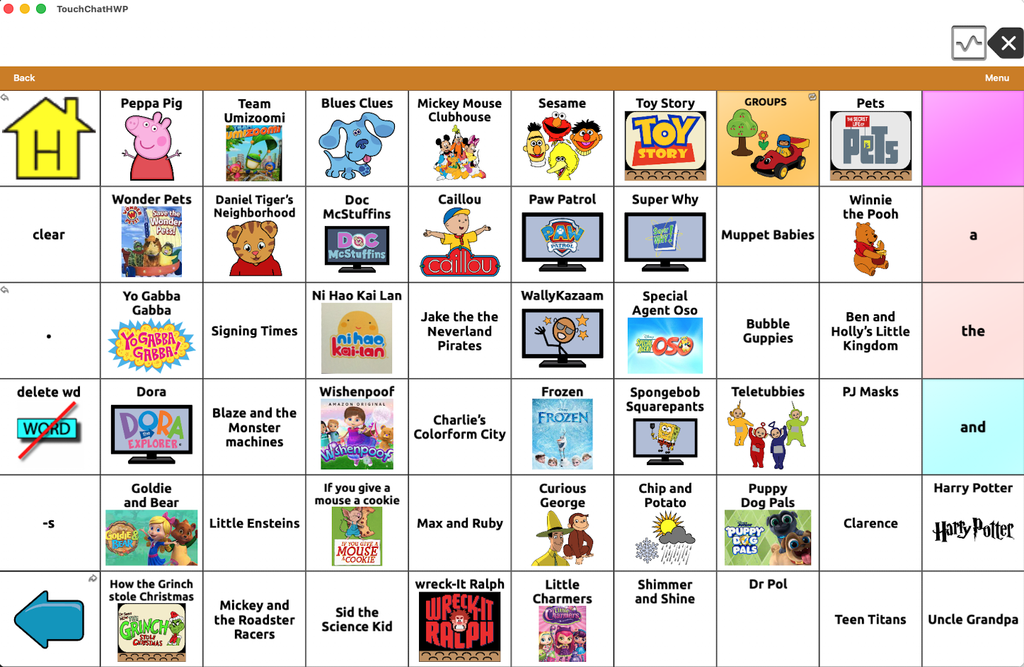
3. Plan to revisit and update the vocabulary regularly
As Beukelman, McGinnis, and Morrow (1991, p. 171) put it, vocabulary selection is “a dynamic process that attempts to capture the changing experiences, interests, and knowledge” of the person using the AAC system. Vocabulary selection is not a one-time task. It is an ongoing process that changes as the person who uses AAC changes.
4. Core word lists aren’t the whole picture for early communicators
Laubscher and Light (2020) found that core vocabulary lists don’t reflect the language of early symbolic communicators and don’t fully capture the kinds of words that dominate early expressive language. Core vocabulary lists are a valuable starting point, but they are usually built from the research on adults (Beukelman et al., 1984). Young children tend to use words tied to their own routines, people, and play.
Binger et al. (2024) note that devices for early symbolic communicators need both core and fringe words. Core words (more, go, stop, want) are flexible and work across many situations. However, a child’s first 50 words are often familiar nouns, such as animals, foods, and toys. These words name things that stand out to the child, like things that make sounds (bark, meow) or move (roll, run, drive). In other words, fringe words.
5. Store whole utterances for quick access
King et al. (1985) point out that whole utterances should be stored for rapid retrieval, such as for small talk and other time-dependent activities. Some language can’t wait for a child to build it word by word. Phrases like “How are you?” help children keep up with fast-moving social moments.
Want help getting started?
We’ve put together a free vocabulary customization guide, available in English, French, Portuguese, Spanish, and Vietnamese, to help you personalize a communication system for your child or client. Find it on our Free Resources Page!
References
Beukelman, D., McGinnis, J., & Morrow, D. (1991). Vocabulary selection in augmentative and alternative communication. Augmentative and Alternative Communication, 7, 171–185.
Beukelman, D., Yorkston, K., Poblete, M. & Naranjo, C. (1984). Frequency of word occurrence in communication samples produced by adult communication aid users. Journal of speech and Hearing Disorders, 49, 360-367.
Binger, C, Magallanes, P, Miguel, V, Harrington, N, & Hahs-Vaughn D. (n.d.). How Toddlers Use Core and Fringe Vocabulary: What’s in an Utterance? American Journal of Speech-Language Pathology. doi:10.1044/2024_AJSLP-23-00366
Fallon, K., Light, J. & Paige, T. (2001). Enhancing vocabulary selection for preschoolers who require augmentative and alternative communication (AAC). American Journal of Speech-Language Pathology, 10, 81-94.
Frick-Semmler, B. & Bean, A. (2023). Vocabulary Selection and Implementation in Vocabulary Interventions for Speech-Generating Devices: A Scoping Review. Perspectives, 8, 1469–1484.
King, J., Sponeman, T., Stuart, S. & Beukelman, D. (1995). Small talk in adult conversations: Implications for AAC vocabulary selection. Augmentative and Alternative Communication, 11, 260-264.
Laubscher, E. & Light, J. (2020). Core vocabulary lists for young children and considerations for early language development: a narrative review. Augmentative and Alternative Communication, 36, 43-53.