
Parent education in augmentative and alternative communication (AAC) has been linked to positive changes in children’s communication including improvements in spontaneous communicative utterances, new words, and comments. Furthermore, improvements in family confidence using a speech generating device (SGD), increased frequency of SDG use at home, increased parent responsiveness to communication, and increased success in communicating with their children have been identified following parent training.
Overall, parent instruction is a contributor to positive outcomes for individuals who use AAC. When families are not given adequate support regarding integrating an AAC system into a child’s daily activities, problems can arise and the AAC system may be viewed as a burden. Negative family attitudes and perceptions can become barriers to AAC implementation and lead to device abandonment. This is why parent education should be routinely provided as an intervention when children first receive a speech generating device (SGD).
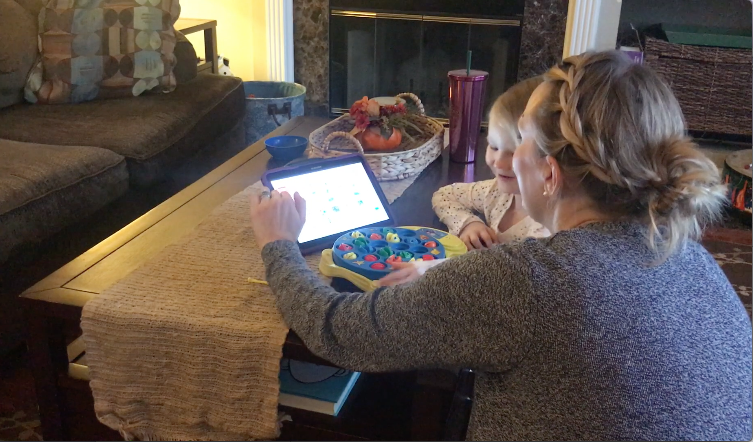
However, simply giving parents links to a YouTube video to watch or giving them a one-time crash course rarely results in successful integration of an SGD at home. In fact, the research tells us that parents learn best when they practice the skills they learn on their own children and when training is implemented in everyday, meaningful routines and activities. Coaching, live observation and feedback in the natural environment, is particularly important in interventions with children with complex communication needs. The SMoRRES® Training Program allows parents to practice AAC-modeling at home, during routine activities, with their own children, with experienced coaches providing guidance.
If you want a speech-generating device to be used outside of 1:1 therapy sessions, family education is the key to generalization.
References:
- Senner, J. E., Post, K. A., Baud, M. R., Patterson, B., Bolin, B., Lopez, J. & Williams, E. (2019). Effects of parent instruction in partner-augmented input on parent and child speech generating device use. Technology and Disability, 31, 27-38. DOI: 10.3233/TAD-190228